
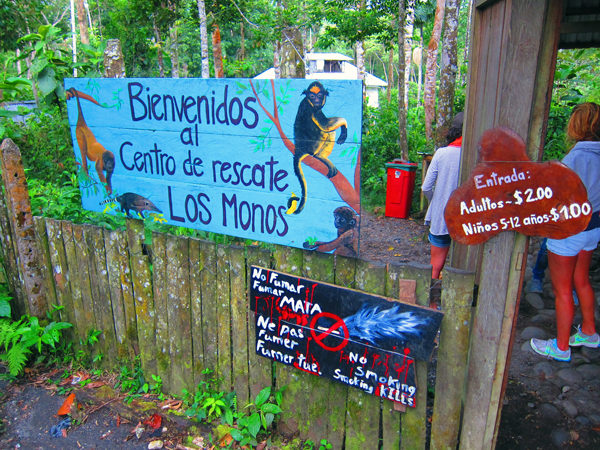
The trip to Paseos Los Monos almost never happened. I was enjoying my time in Baños and questioned if the hour bus trip to Puyo for a typical, over-staged monkey photo was worth it. I was also a bit hesitant to see how tourists and staff interacted with the monkeys, seeing too much poor treatment with animals here in South America. Reluctantly, my curiosity and fascination for animals won out.
By the time I arrived at Paseos Los Monos the predictable afternoon rain picked up and the morning crowd had come and gone. Aside from a large group of Ecuadorian tourists, the grounds were quiet and the staff seemed lethargic.
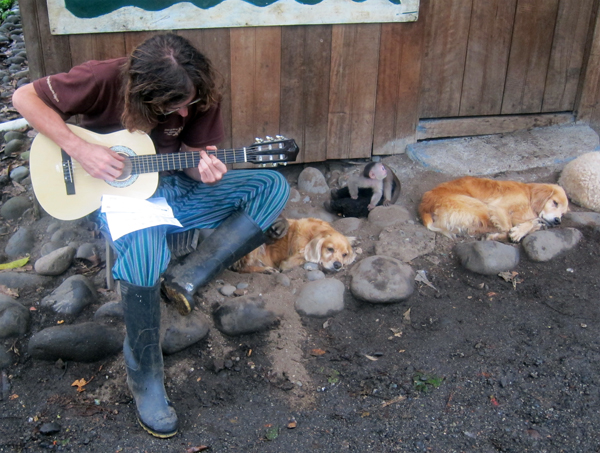
I was greeted by a young Spanish guy (Yago) who collected my $2 entrance fee and explained the do’s and don’ts of the center. I listened momentarily but my attention was inevitably drawn towards the scene beyond the main gate. I nodded in agreement and he motioned me forward.
Like a scene out of Swiss Family Robinson, monkeys scampered by freely as I cautiously made my way down the dirt path towards the main building.
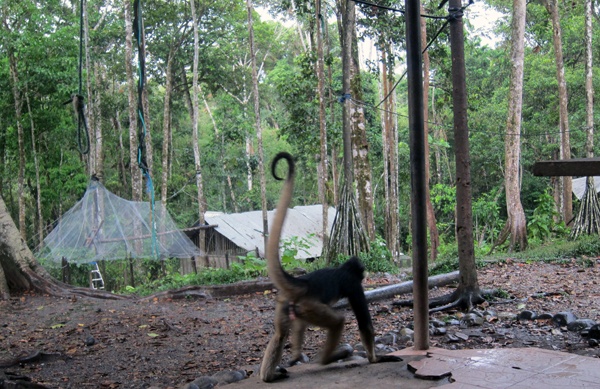
About an acre of land had been cleared from the thick Ecuadorian forest to develop the site. Narrow paths cut through the property’s foliage and past the tall metal cages that bordered the center. The main building sat in the middle of everything and was heavily fortified with chain link fenced windows and patios.
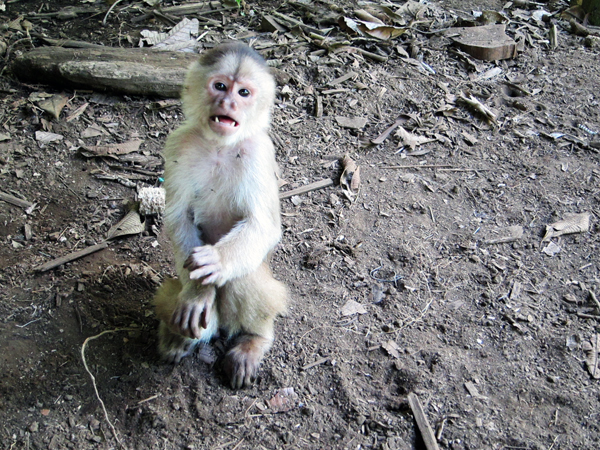
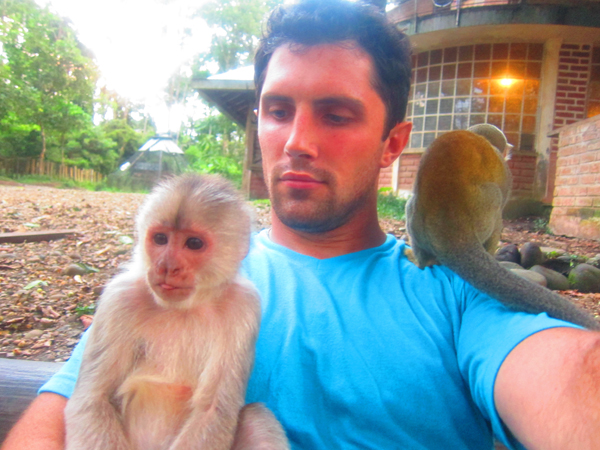
I distanced myself from the tourist group and took a seat behind the main building next an older Ecuadorian woman wearing a staff shirt. She was relaxed on a wood bench surrounded by napping dogs and monkeys and welcomed me to sit and chat. As I began asking questions, two woolly monkeys climbed up into my lap and settled in.
Just as quickly as they took to me, I embraced the magic of this place.
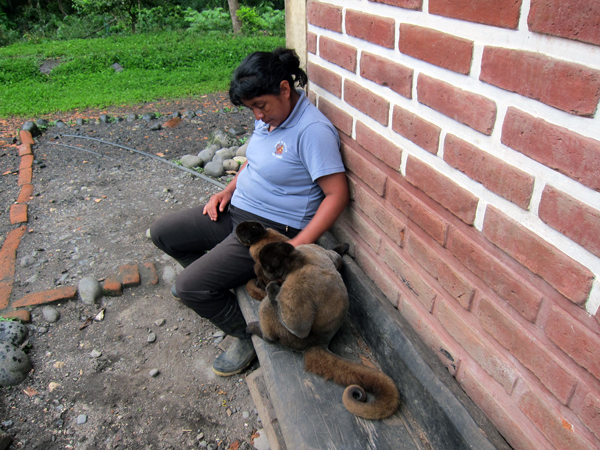
Elena (the staff member) explained to me how Paseos los Monos used to be filled with a variety of animals like crocodiles and sloths, but have recently focused their attention to the recovery of displaced or mistreated monkeys. In Ecuador, many people keep monkeys as pets even if they don’t have the capacity to properly raise them. Although it’s illegal, she mentioned no one has ever been arrested for it.
She continued explaining that it’s the objective of the Paseos los Monos monkey rescue center to receive these mistreated animals, help them get healthy, introduce them to a group of their species and eventually release the entire group (together) back into the wild.
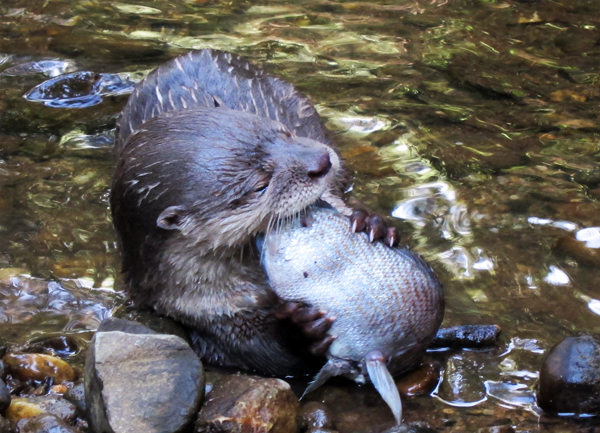
Currently there are 64 monkeys of 6 different species at the center, all with their own names and backgrounds. The monkey center is also home to 4 coatis (raccoon family), parrots, giant tortoises, family dogs and one crazy otter named Adam.
As we continued talking, we were joined by a few other staff members who explained they had been volunteering here for a few weeks and suggested I stay and help out. I thought for a second, mentally clearing my schedule and accepted almost immediately.
They called for Muriel, a tall thin French women, who managed the volunteers and she explained that someone had bailed so she had space available. If I wanted to stay I could pay $100 for a week of room and board.
I told everyone I’d see them in the morning.
I arrived the next day dressed and ready to work. I wanted to prove right away that I was there to help, so I offered my assistance everywhere and the crew was receptive.
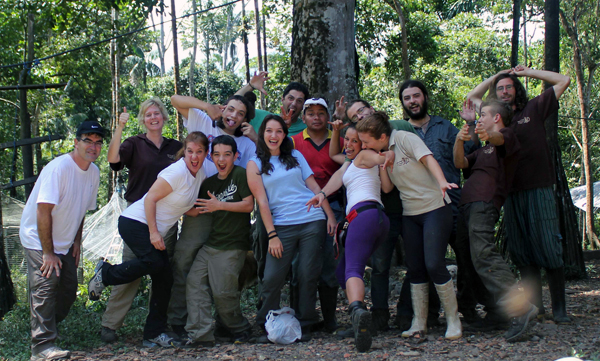
Paseos los Monos Centro de Rescate (Monkey Rescue Center) is owned by a cigar smoking Swiss guy named Yvan and managed by an entertaining all-knowing Ecuadorian named Jamie and his wife Elena. In between, is Muriel (mentioned above) and Danny, our Ecuadorian cook and his brother Christian.
Long-term volunteers included a sassy Colombian named Viviana, Franck and Alex from France, Gaia and Yago from Spain and Quin, a young British bloke. Also, for a short-term, overlapping with my time, was a nice Dutch girl named Danielle and a great American family including mom and dad, Cindy and Joel, and 3 teenage kids, Sarah, Devin and Nick.
MY DAILY SCHEDULE
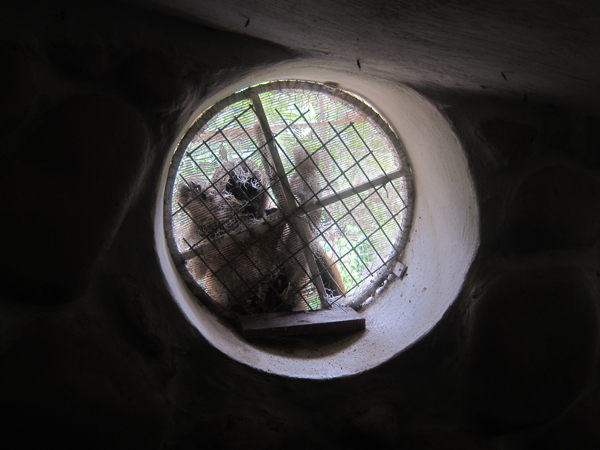
7:00 am – Wake up, shower and get dressed. The moment it all sunk in was on my first morning shower when a trouble-making spider monkey named Lola was spying on me through the chain link fenced window. It was amazing but awkward at the same time.
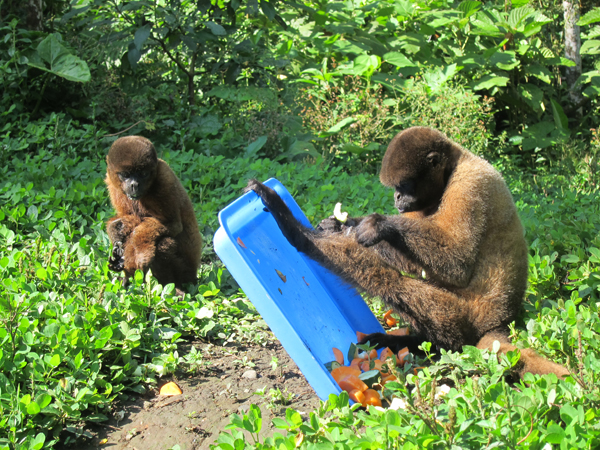
8:00 am – Breakfast for monkeys. We chopped up fruit and veggies and divided them between the different animals, species, cages and diets. While many of the monkeys were free to explore the center some remained in cages because they were either more aggressive, at risk of running away (dangerous for them) or preparing to re-enter the wild.
9:30 am – Humans eat.
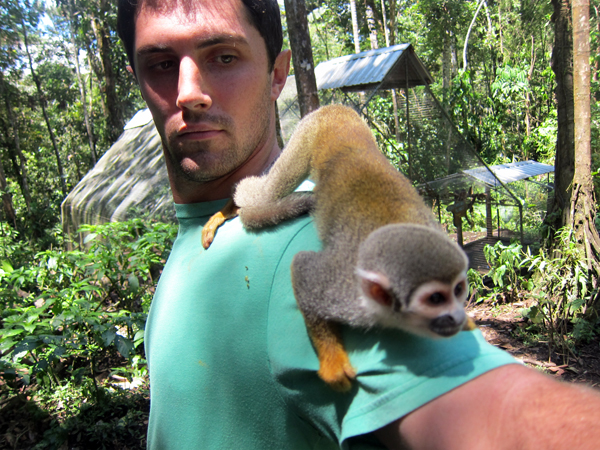
10:00-2:00 pm – Work shift. This included building new cages, cleaning, guiding tourists and constructing a new path down along the river. I spent 3 days working with a makeshift pulley and wheelbarrow carrying rocks and pebbles from the creek to create a new path around the property. This was to help spread tourists out on busy days so the animals wouldn’t get overwhelmed. It was incredibly rigorous work but I loved every moment of it. The wild thing about it was, out of nowhere a squirrel monkey would jump down from a nearby branch on my shoulder to oversea the work or a woolly monkey would climb into the emptied wheelbarrow for free ride. I couldn’t help smiling even though I was soaking in sweat.
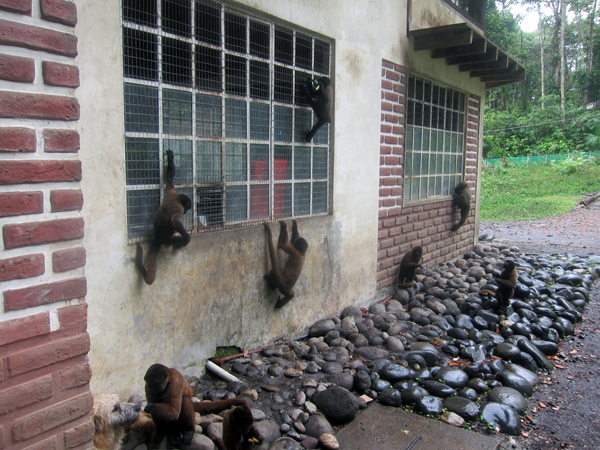
2:00 pm – Lunch for monkeys. The monkeys scale the giant, chain link window and howl as we prepare their second course. When we bring the food outside I had to hold on tight to the trays because they’d run and jump up on your legs, arms and shoulders to grab the first piece of mango or pineapple.
2:30 pm – People eat.
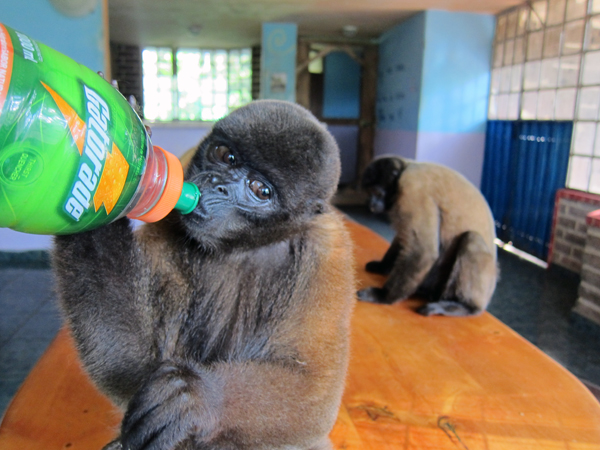
3:30 pm – Let the girls out & clean cages. Every afternoon after lunch, the dining area is cleaned and secured for the release of 5 caged female woolly monkeys to run around the house. For the reasons I mentioned about, they’re not allowed outside without a leash, so this gives them the space they need to play freely. All the doors are locked, the kitchen cabinets are tied and furniture is turned upside down, yet somehow they still manage to get into something every time. It’s not the most sanitary of events, but hygiene doesn’t really take high precedent here (which is a little unsettling).
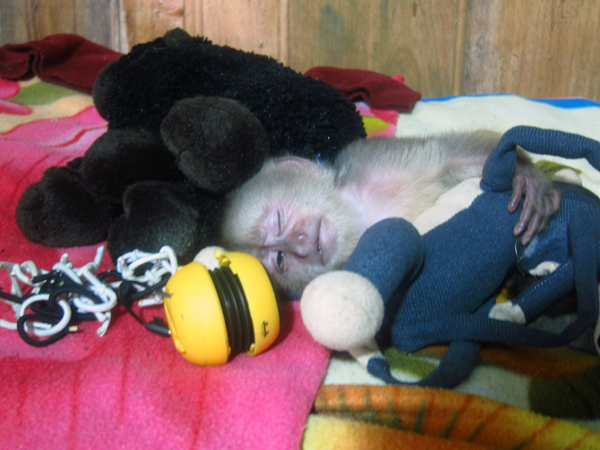
5:30 pm – Clean everything & snack. After a nice afternoon snack (for the monkeys) the girls are put back into their clean cage, the baby monkeys are taken inside for the night and the last of the tourists leave. Now we clean the house and equipment we used for the day.
7:00 pm – Enjoy the tranquility. Every evening from about 6:30 until the forest grew dark around 8pm, I would find a bench, log or dry grass around the property and just chilled with the monkeys. This was my favorite part of the day. I made an unlikely connection with the alpha male of the woolly monkeys, Sambo, who wasn’t usually keen on hanging out with people. The majority of the evenings, he would swing down and sit with me as I soaked in and he surveyed our surroundings.
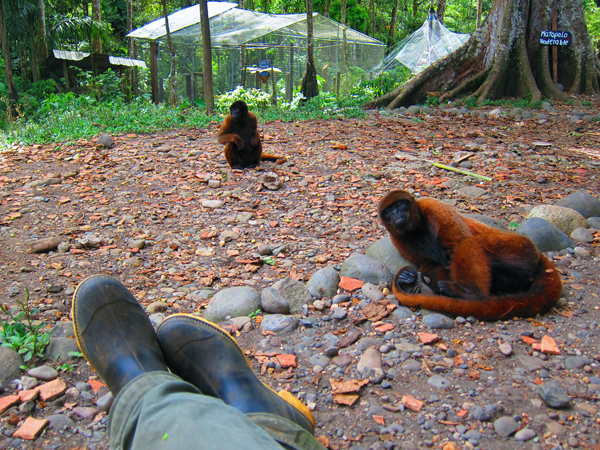
8:00 – 11:30 pm – Shower, relax, dinner, lights out.
FINAL THOUGHTS
Volunteering at Paseo los Monos was one of the most unique and inspirational experiences of my life. The environment is refreshing, the staff is incredibly dedicated and the animals are fascinating in that every single one has their own unique personality.
I can’t begin to explain all the personal encounters or funny events that took place this week, this post could easily be 5000 words, but I still don’t think it would do justice to the energy I felt.
It is something I will remember forever.
I hope the rescue center can continue to develop even with scrutiny from government to close places like this because of their liability. I think if they can continue progressing organizationally and strengthen their long-term vision; Paseos los Monos has the capacity to literally save hundreds of animals, not just monkeys, from mistreatment in Ecuador.
HOW WE CAN HELP?
Inevitably when I left the Monkey Rescue Center, the staff and animals affected me deeply. I thought about what I can do to help. I spent a lot of time talking with staff at the center about the resources they needed and I’m going to work on some type of donation platform on the site. The first thing I want to do is buy them a power washer to help with making cleaning projects more efficient and effective. I’m not sure how I’ll do it exactly but when I figure it out I will keep you all posted.
I’d love to help protect the future of this amazing program.
VIDEO COMING SOON!

very cool – I can’t wait to see the video!! Dave and I use to have two spider monkeys but they couldn’t handle sunday funday.
Didn’t you guys get them because you saw Jack Sparrow with them on the Pirates of the Caribbean?
How was it like when we left.
Hello my name is Anne-Kathrine .. Can you help me find the website of this program. I really wanna know more about it. I have always dreamed about working with monkeys 🙂
Anne-Kathrine Utzon recently posted..Do you dare ?
Hi Anne-Katherine, unfortunately they are going through some changes and have recently released all volunteers. The owners at this park are not treating the animals the way they should be treated and people are working to step in and change it. Not a great time to visit, but I have heard of other programs that are more stable in Ecuador and Peru that you should research. I’m sorry I couldn’t be more help.
Any info on how I could get an opportunity to volunteer here?
Hi Gareth!
I was wondering if you have any information about the recent activities of Paseo de Los Monos.
I’m thinking of going there in July 2013, but I’m not sure it is such a good idea reading your comment about the changes (to anne-katherine).
It seems the Paseo Los Monos is taking volunteers again. Here is a blog from someone who was just there for two months:
http://hanginwithmonkeys.wordpress.com/2012/09/06/first-days-in-the-jungle/
Hi! I’ve been reading your site for a while now and finally got the courage to go ahead and give you a shout out from Arizona. Just wanted to tell you keep up the excellent work!
I visited Paseo de Los Monos in late January of 2012. It was by far the worst experience I’ve ever had traveling… It seems like it went down hill after your crew left. The owners seemed completely disorganized and one of the main founder (the Ecuadorian guy?) seemed to have fled his own project. Also, Samba was overthrown by an even more aggressive alpha monkey. I’ve heard various rumors that they were shut down, which I hope is true.
Hi Gareth and people of the blog: I am the biologyst of the rescue center Paseo de los Monos working for a long time with this animals. It is not true that the project is down or desorganized. We work in accordance to the local environmental authorities and still receive volunteers from all over the world. The animals are in great conditions, living in native forest inside family groups. Sambo already adopted two babies and Milton one baby named Jack. We do rehabilitation to mistreated animals from traffic and liberate some. We are working now in the new project with the Serpentarium and much more. I invite you Gareth and all the people to visit the place and cooperate with the best project with wildlife in Puyo Paseo de los Monos.
Carolina,
Will you post your website? I am interested & have found multiple organizations.
Thank you. Elisa
I was searching for “El Paseo de los Monos” & thought that would be the name of the website.
I believe this is the site name/page:
Fundación Los Monos, Selva y Vida
Webpage: http://www.losmonos.org/Inicio/pagina-en
The website mentions El Paseo de los Monos.
Awesome! Trying to find a sanctuary where my girls( mature 7and 10) can help out with me for a week in august. Would they be willing to let kids volunteer?
Their volunteer page on their website says: (http://www.losmonos.org/Fundacion/ver-pagina-en/99999)
“To be at least 18 years old. Children and teenagers must be accompanied by a relative.”
I’m in Ecuador now with my 10 y/o. We’re headed to Puyo tomorrow. I’ll see if there is someone I can ask.
Hi Victoria and Elisa,
By chance i returned to this blog and read your comments. It will be a pleasure to receive you in the project as well as the kids. There is no better educational program than helping animals in a friendly environemnt into the wild jungle. Please, for more info write to paseoecologicolosmonos@yahoo.es so i can personally attend to your questions.
Ihope to hear black form you soon.
Kind regards,
Carolina
Amazingly, the volunteer team did very well to save such lovely monkeys. A meaningful animal protection program.